Personal Trainer Tips to Set Up A Small Home Gym - The Basics
- Marios Iacovou

- Aug 29, 2022
- 3 min read

Many of my personal training clients are not interested in joining a gym. It's an extra cost, gyms can be pretty unpleasant and often lots of time is wasted travelling to the gym and back.
Fortunately, they do not need to join a gym.
They can get just as great results in meeting their health and fitness goals from home, from their dedicated home gym space.
What you require in your home gym space will largely depend on what your goals are.
Here are some of my thoughts and suggestions on how to go about creating the perfect functional space to get you moving;
1) The Right Space For A Home Gym
Here you can go big or go small. Do you want to convert the unused garage into a gym or do you simply want to use a corner in your bed room? Ideally you'd be able to find a minimum of 2mx2m floor space.
You may even have some space to exercise and store equipment in a garden.
Make the space comfortable and protect your floors, (and knees!) by buying gym floor protective mats or simply a yoga style mat to roll out.
Good lighting and ventilation will be more important than you first realise.
2) Get the Right Home Gym Equipment
More is not necessarily best.
First ensure there's a mat to protect the floor from damage and to feel more comfortable on your wrists and knees. I got mine from eBay. The mats I use are like a jigsaw puzzle style and you can cover as much space as you choose. They are also easy to clean. Warning; cats and dogs do love a chew on these.
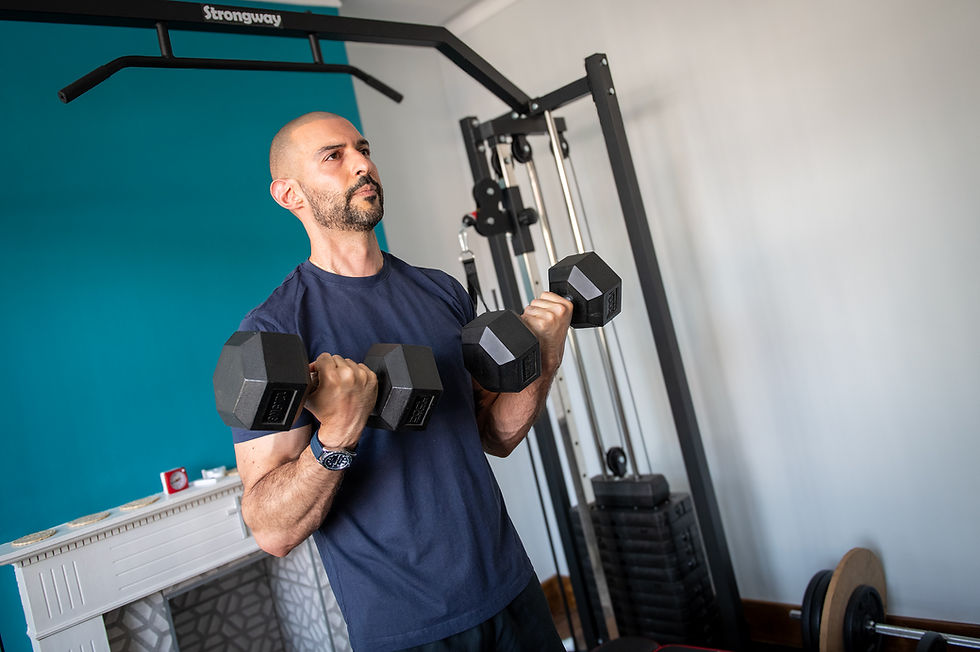
Consider getting dumbbells - adjustable dumbbells replace the full rack- but are typically £350+ a pair so can be quite a big outright investment. At least you'll pay that back within a year by not joining the gym.
A cheaper option is getting dumbbells with plates where you can make the weights up as you choose by adding and removing the plates yourself. These are a little bit time consuming but they take up much less space than getting a number of fixed weight dumbbells and it's also much cheaper.
If you have a few pairs of fixed weight dumbbells at home these can be really useful and you can simply adjust the rep numbers to get the most out of them. For example if you only have a light set, you can do more reps and vice versa, though this is a shorter term solution. Of course, after a while you may choose to upgrade to a fuller set of weights.
You may also consider getting barbells - not necessary as you can simply use the dumbbells.
A gym bench is also a useful investment, typically from £60. Useful though takes up quite a bit of space. You can buy some standing ones and ones that can easily be put away under the bed (as long as you make sure to not leave the bench there, forgotten and dusty). An adjustable bench is best - the ones with an incline.
Resistance bands are versatile and cheap. A kettlebell can be very useful too - select a moderate weight and buy just one to start with. A jump rope is also a good, low investment idea.
A well placed and large enough mirror, securely placed to watch your form.
You may also consider buying an exercise bike or a treadmill.
3. Make Outdoors Your Gym
Take your mat in the garden and enjoy body weight based exercises. Also consider getting out for a run in the park as another cardio option. Do dips on the park bench,
4. You've Created The Home Gym - USE IT
I would suggest first starting small. It doesn't need to be perfect. Start minimal so that you add only what you actually use.
When it comes to exercise, consistency is key. It's better to have a few good items that you feel happy and comfortable and motivated enought to use, than a mega home gym which is never touched and collects dust.
After all, a home gym can only help you towards meeting your health and fitness goals if you use it.
If you need some support to get started on your health and fitness goals, contact me to chat.