The Body You're Chasing Probably Isn't Natural - Personal Training, Gay Culture & Body Enhancing Drugs

Seventeen years of personal training people, watching bodies transform, building strength from scratch, and never have I touched anabolic steroids, HGH, SARMs, peptides, or any other performance-enhancing drug.
I want to talk about why but more importantly, I want to talk about the culture that makes that feel like a confession rather than the norm.
The Numbers Don’t Lie - Steroid Use Among Gym-Goers is High
Let’s start with some honesty about the fitness industry, because most of what you see online is built on a foundation that nobody wants to admit.
Studies estimate that between 64–84% of competitive bodybuilders use anabolic steroids or other PEDs.
Among recreational gym-goers who train seriously for aesthetics, surveys suggest figures of around 35%, and that’s just the people who admit it.
The real numbers are certainly much higher.A 2019 survey published in the Journal of the International Society of Sports Nutrition found that anabolic steroid use in gym populations is significantly underreported. In the UK, an estimated 1 million people have used anabolic steroids at some point — a figure from Public Health England.
Instagram fitness culture has turbocharged this.
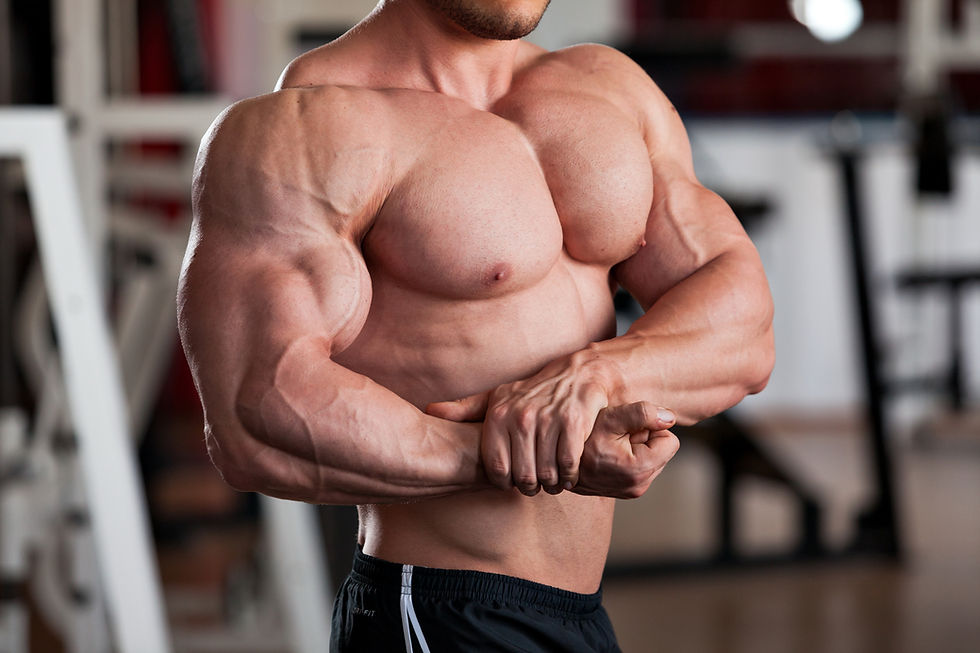
The physiques held up as aspirational. The round, capped delts, the paper-thin skin, the vascularity, the permanent stage-ready look, are, in the majority of cases, chemically assisted.
Yet they’re sold as the result of discipline, meal prep, and pre-workout.
The supplement industry, worth over £50 billion globally, profits enormously from people chasing results that their product cannot and will never actually deliver.
What I’ve Seen Up Close
I’ve been doing personal training sessions with hundreds of clients over the years. Only a couple, in all that time, (that i know of, have started using steroids whilst training with me.
I remember the sessions clearly. Incredible and rapid strength gains, and size gains. This didn’t come from the programme alone (though programming is very good if I say so myself)
One thing in particular that stood out was the mood changes. One week enthusiastic, motivated, almost euphoric. The next, withdrawn, irritable to the point of aggression. Not at me particularly, but it was always there, a tension just beneath the surface, like something could snap at any moment. They let me know that it was affecting their work and personal relationships too.
They weren't themselves either, or at least not a stable version of themselves. Soon after, in both cases, they decided that it was best to stop with the enhancement drugs and even today have not gone back to them, which I'm very glad for them.
The clinical evidence backs it up. Anabolic steroids significantly affect the hypothalamic-pituitary-gonadal axis, disrupting natural testosterone production, often permanently.
Side effects include:
-testicular atrophy,
-liver toxicity,
-cardiovascular damage,
-polycythaemia,
-mood dysregulation,
-and dependence.
Studies have linked long-term steroid use to a significantly elevated risk of left ventricular hypertrophy and sudden cardiac events, even in people who stopped using years prior.
The Gay Culture Body Image Problem Nobody Wants to Say Out Loud
I run an inclusive personal training space in London.
A meaningful part of my client base is gay men, and I care about my community deeply, which is exactly why I say uncomfortable realities like this;
Gay male body culture has a serious, under-stated relationship with PEDs, and with body dysmorphia more broadly.
Of course, this isn't a surprise to anyone reading within the gay community! Noone likely reading this is sitting mouth open with shock.
Research consistently shows that gay and bisexual men experience higher rates of body dissatisfaction and muscle dysmorphia than heterosexual men.
A study in Body Image journal found that gay men were significantly more likely to engage in excessive exercise and steroid use as a response to appearance-based pressure from within their own community.
Apps like Grindr (which I generally consider disastrous for the gay community) have intensified this where bodies are literally commodified and sorted.
The message, often unspoken but impossible to miss, is: you are only desirable if you look a certain way.
The “big arms, shredded abs, visible veins” ideal that dominates gay male visual culture on apps, at Pride, in gay media.
This is largely a chemically engineered aesthetic being held up as a standard of natural human potential.
When men who are training naturally, eating well, and living healthily compare themselves to it, they inevitably feel inadequate. That gap between expectation and reality is precisely where body dysmorphia takes root.
I’ve had personal training clients come to me ashamed of their bodies after years of genuinely good training. Not because something had gone wrong, because they were doing really great and looking strong, but because they were comparing themselves to people on these drugs.
Why I’ve Never Done It
People sometimes assume my reason for staying natural is purely ethical or professional. It’s not really that, at least it's only a part of it.
I’ve been training for all of my adult life. I’m vegan. I now follow a lower-carb approach.
I take my health seriously - not as vanity, (okay a little bit, hmm maybe quite a lot, in some ways, as vanity) but as an expression of how I want to live. The idea of introducing synthetic androgens into that, disrupting my endocrine system, loading my liver, potentially altering my mood and mental state, runs counter to why I train in the first place.
I generally train because it makes me feel good and I want to stay healthy and independent.
Because the discipline is its own reward. Because being strong at very nearly 40 years old, with a clear head and a stable mood and a body that functions well, that’s the goal.
(There’s also the matter of honesty as I am a personal trainer. My body is, to some extent, my advertisement. If my results were chemically assisted, showing them to my clients would be a form of deception, it would be an implicit lie about what’s achievable naturally).
Something I find harder to articulate but that matters enormously to me. The connection between how I care for my body and how I care for my inner life. I don’t think these are separate things.
A practice of sustainable, attentive, physical training is, for me, continuous with a broader commitment to living with integrity. Taking shortcuts that damage my long-term health to look impressive in the short term would feel like a betrayal of something I’ve built slowly and carefully over many years.
Natural, long-term training - what you actually gain when you commit to it;
You gain consistency, no crashing after a cycle, no hormonal chaos, no months of loss when you come off.
You will build muscle slowly, but you will keep it more sustainably.
You gain self-knowledge. You learn what your body actually responds to. You learn its limits and its genuine capabilities.
There’s something deeply satisfying about knowing that your strength is genuinely yours.
You gain mental health. Exercise is one of the most evidence-backed interventions for anxiety and depression. But that only works when training is a relationship with your body.
You gain longevity. I want to be healthy and strong at 60, 70 and beyond.
That goal requires a completely different approach than trying to be as big as possible now. The cardiovascular and endocrine damage from long-term steroid use doesn’t show up immediately, it shows up later, when you want to still be thriving.
And you gain freedom from the comparison trap.
When you stop trying to achieve a shape that is in fact typically a chemically-assisted aesthetic, you can begin to value your body for what it can do, how it moves, what it endures, how it serves your life, rather than how it measures up to an artificially constructed ideal.
What I Tell My Personal Training Clients
My clients choose to train with me, in part, because they know what they’re getting. Honest training. No shortcuts. No pressure to look like someone on a magazine cover, but of course, I encourage aiming to reach a healthy natural potential.
This is why we work together, with personal training built built for their body, their life, their goals.
Some of my clients, have come to me after spending years in mainstream gym culture feeling inadequate. Some have come from communities where the pressure to look a certain way was relentless. Some have come carrying shame about their bodies that had nothing to do with their actual health or fitness.
My job isn’t to give them an extraordinary physique, (though I want them to be proud of their body shapes through the hard work they put in and to look and feel great).
My ultimate job is to help my clients to feel at home in their body, perhaps for the first time.
To show them that consistent, loving, sustainable effort produces real and really great results!
That they don’t need to be anyone other than themselves. That strength is worth building slowly, because the slow way is the way that lasts.
That’s what I believe and that’s how I train, and that's how my clients train.
Let's start your health and fitness journey together, for effective yet safe and sustainable results. Real results. Really really great results!